Friday, February 17, 2017

Dave’s Anatomy: My History As a Writer #94: The Past As a Good-Bye: “Gimme Shelter”


As a guitarist and a Rolling Stones fan, it’s natural that some of my stories come from those things. I write a lot about musicians:  realistic stories about the trials of being in the music industry, stories where musicians encounter the supernatural, tales of musicians and their relationships. I can draw on my own experience, my knowledge of music, and elements in popular culture for plot ideas. And I created an ongoing character, Sossity Chandler, who toils and plays in bars and small venues until she makes it big and becomes a pop music superstar. The story for today, “Gimme Shelter,” uses that particular song as a jumping off point for a story about a guitarist who has found his niche in the world of music writing and his on/off girlfriend, Orion (Orion is pronounced like the Lake in Michigan, not like the constellation). He learns a lesson about himself from the song.

Orion

In the story, Eliot is with Orion. In their early days they both have aspirations to make it as musicians, and they both faith, though in different ways. Eliot ends up going into the academic world, earns an advance degree, finds a job, and is able to make it the world of scholarship. Orion tries to establish a career as a singer but has little success. She lives a hard-scrabble life, working from gig to gig, hardly making enough money to get by. Eliot’s career takes a turn when he grows weary of purely academic writing and pens a book on British acoustic guitar players. It is an unexpected best-seller and catapults him into the world of music writing.

He maintains a relationship with Orion. They continue as occasional lovers. He gives her money when he senses she is barely getting by. When he does research on themes related to music and popular artists, she often accompanies him. Just off a breakup with a woman he had hoped to marry, he goes with her from their home in Grand Rapids to Lansing, where she is playing a gig in a bar. On the way up they listen on old Rolling Stones records and comment on the music. Despite the fact that he talked about her in an article on upcoming blues artists that was published in Billboard, her career is not going well. She is out of money. He does the usual thing of giving her a large amount of cash to buy them drinks. She will keep the substantial cash that is left over.


As he is watching Orion play, a woman sits down with him. She is also a college instructor and likes his writing. They talk literature. She mentions an article he has written about Michigan author Bonnie Jo Campbell. She says she likes his analysis of the story: “The main character’s interpretation of his relationship to Belle when they were teenagers is the opposite of her interpretation. He saw himself as her savior and champion in those early days; she saw him as someone who sexually exploited and took advantage of her.” He mentions a similar theme in Julian Barnes’ novel The Sense of an Ending. It is obvious the woman is coming on to him, but in the middle of the conversation he has an epiphany—a moment of realization. He says he needs to go, she leaves her phone number. He thinks about Orion and how he has treated her:


As he picked up his guitar case, he realized how he had exploited her—yes, he told himself, exploited described it perfectly. In graduate school he had depended on her for emotional support when he was fatigued, discouraged, or overwhelmed—frequent occurrences for graduate students. More than once she had typed papers for him. She had always been willing to sleep with him when she sensed he needed it. She stuck with him when he was down and as a “friend” when Janelle was cutting him to pieces. She had always been there. Through the years she had borne his whining and condescension like a patient mule. She had supported him emotionally. And how had he responded? He had screwed her, given her money when she was broke, attended her concerts—and when he attended her concerts, they usually ended up in bed together. Exploitation—flat out, no way to sweeten what he had done with a euphemism and no excuse for it.

Eventually, as he and Orion have agreed, they do a couple of songs together. Afterwards, he says he wants to talk to her. She senses his agitation and wonders what is going on. He asks if she knows a place where they can go to talk. Still puzzled at his behavior, she suggests a coffee bar she knows that is open 24/7.

I let the reader imagine what will result from his epiphany, his moment of realization (a technique made popular by Irish writer James Joyce in his short story collection Dubliners). The fact that he has seen his behavior in this new light is at least hopeful.


The story appeared in the online journal Intellectual Refuge. Read it here.

For additional titles, check out my Writer's Page.

A great read is my vampire novel, Sinfonia:  The First Notes on the Lute, A Vampire Chronicle, Part I.  Get a copy here.


I would to hear your comments. Happy reading.  

Friday, February 10, 2017

Dave's Anatomy: My History as a Writer, #93: Ghosts and Justice: "Plantation Ghost."


Ghost of Hamlet's Father

Ghosts are not just ghosts. They appear in stories not just to scare us but to teach moral or sociological lessons. The four ghosts that appear in A Christmas Carol—ghost of Marley, of Christmas Present, Christmas Past, and Christmas future—are part of a novella about social justice and fairness for the poor. The ghost of Hamlet’s father asks for revenge after he is murdered so his brother can make himself king. The ghost in Toni Morrison’s Beloved, described as “spiteful. Full of a baby’s venom,” is an icon calling attention to racial injustice and the suffering of African-Americans during the years of slavery in the United States. In my story, “Plantation Ghost,” I try to illustrate some aspects of racial conflict in America through the presence of a ghost. The story calls focuses on this, but also illustrates the complications of being black and white in our society.

Rebecca Hayes, the bass player in Sossity Chandler’s band, is black. She has been dating the band’s drummer recently, who is white, but they have split up—sort of. Rebecca has caved in to pressure from her family to break the relationship off. But that has not been as easy as she has imagined it would be. For one, she loves Todd and he loves her. During the story she goes in to confront him and ends up making love to him. She is frustrated, as he is, knowing she has to take decisive action to end the relationship but not really wanting to.

When the band is doing a series of concerts in Alabama and Georgia, Rebecca and Sossity share a room at a plantation that has been turned into a B&B. Rebecca wakes up in the middle of the night to see a tall, slender black woman dressed in garments that suggest the 1800s standing at the foot of her bed. The figure vanishes and Rebecca writes it off as a dream. At the breakfast table that morning one of the guests asks if anyone there saw the ghost. Rebecca asks about it and finds out more:

“She is one of the most well-known ghosts in the area,” the white businessman, who had a heavy Southern accent, was saying. “This place was deserted for years because of her. More than one family moved in and the ghost supposedly drove them off.”
“Did the ghost go away?”
“A few people say they’ve seen her, but I guess she’s a little calmer—so calm she hasn’t rattled chains or terrified anyone lately.” Everyone around the table chucked at this. “People who have seen her identify her as a woman who worked her as a servant in the Reconstruction era, though, sadly, we don’t even know her name. She died a victim of racial violence, I think.”
Since racial violence was a delicate subject, the guests quickly moved the conversation elsewhere.

Later, the ghost appears to Rebecca and speaks to her. She tells the story of having been chased by ex-Confederate soldiers after the civil war and being shot. She staggers into a swamp for safety, finally collapses and his found by a white man who nurses her back to health. He lives alone, has lost his wife, and eventually Shoshanna and he fall in love. He is able to pass her off as a farm and worker and mistress, which the other men in the area can tolerate. They live together ten years and have two children. Charlie, the husband, eventually dies during a typhus epidemic. Shoshanna gives the children to relatives to raise and goes off to seek employment. She finds work at a plantation with white people who are fair and kind to her.


But by that time the Ku Klux Klan has become active. They don’t like the family that has hired Shoshanna and begin to harass them and her. One night they come to lynch her. In the struggle, one of their number drops a pistol on the ground. It goes off and kills her. The family buries her and leaves the plantation. Shoshanna becomes a ghost. She haunts anyone who has any connection with the mob of men who killed her—which is most everyone in the town and surrounding area. The plantation sits empty for years until someone from the north buys it and opens it as a bed and breakfast. Rebecca suggests that since Shoshanna has told her story and the direct relatives of men who murdered her are all dead, she can go to her rest. Shoshanna does not reply. She vanishes.

As Rebecca and Sossity are getting ready to leave, the woman who runs the place gives them a tour of the servants’ quarters. A box of old books she is giving away sits on a table there. Rebecca come across Shoshanna’s diary. She tells the woman it might be valuable, but the woman insists Rebecca take it. On the way home, Sossity asks her about Todd. Rebecca says it is over with them. Sossity argues she needs to defy her family and convention and pursue the relationship, since she really does love. Sossity tells Rebecca that she needs to do what is right. Her reply is, I think, some of the best lines I’ve ever written:  “I love him. No doubt about that. You told me I needed to do what was right. But sometimes you can’t do what is right in life. Sometimes you have to do what is wrong.” The story end on an unhappy but perhaps sadly realistic note.


“Plantation Ghost” appeared in The WiFiles. Read it here. The journal, no longer published but maintaining an archive, has a straight-line format, so you'll have to scroll down to get to my story. It's number four in the line-up.

Here's a video for my novel, Sinfonia: The First Notes on the Lute. Vampires, love, music, passion, and intrigue. Also, Shakespeare, and Queen Elizabeth.

For more titles, visit my Writer's Page.

I would love to hear your comments.

Sunday, January 29, 2017

Dave’s Anatomy: My History As a Writer, #92: Postmodernism/Love: “Parody.”

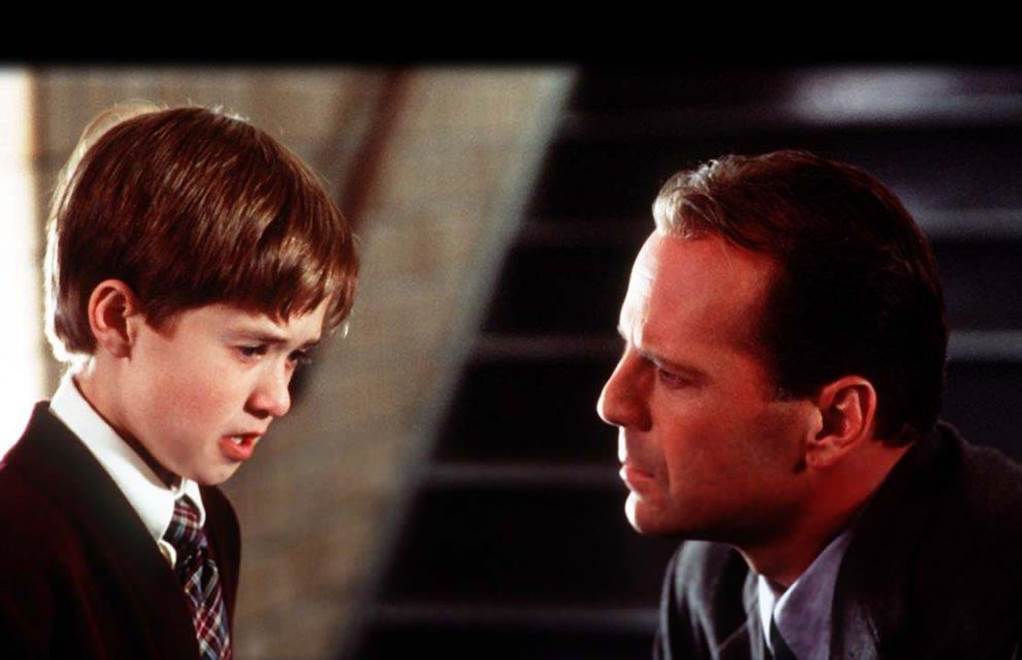
from the film Sixth Sense

Ghost stories are usually not very philosophical. They are scary and reach down to touch our primal fear of the undead, of spirits, of ghosts and wraiths. If you saw the film Sixth Sense, you know that ghosts want something. And, of course, this is more or less an assumption lying behind all ghost stories. An spirit returns to earth not because they want to but because something prevents them from achieving rest and peace after they die—usually, some injustice done to them, something that must be corrected, set right, understood, and let go of. In the story “Parody” a ghost appears who cannot rest because something he has done in life is being coopted by what he believes is an invalid form of art based on an invalid philosophy.

Postmodern architecture

It begins when Andrew Halliway, a musician who is starting to make a name for himself in the world of guitar, sees someone standing on the sidewalk in front of his girlfriend Elizabeth’s apartment. He confronts the man, who disappears. Unsettled, he goes to her apartment. Elizabeth is an architect currently working on a project to expand the City Hall. The project has been bedeviled by delays, broken equipment, and other obstacles.

Elizabeth’s mode of architectural design is postmodern. We hear that term today and usually connect it with literary arts. The French Lieutenant’s Woman is a postmodern novel, Shakespeare in Love is a postmodern film. But postmodernism began as an architectural movement. In Italy, designers of buildings began to defy categories (which is what postmodernism essentially is). They mixed up styles that usually stood as monolithic, designing buildings that had gothic arches and modern steel girders, Romanesque towers and glass and steel entry ways, classic Greek pillars and baroque decoration.

And postmodernism engages in parody. It will copy certain art forms, making light of them in one sense but also calling attention to their brilliance. Writer John Fowles once described a certain type of painting as “simultaneously a tribute and a thumbed nose at a very old tradition.” This is often cited as a definition of postmodernism. And, in my story, it is exactly what Elizabeth is doing in her addition to the City Hall. She is copying the old design in a way that calls attention to its eccentricities but at the same time recognizes its genius and beauty.

Elizabeth

They spend the night together. Andrew gets up before her, goes into the living room, and finds a book on architecture. Thumbing through it, he comes across a picture that looks like the man he saw staring up at Elizabeth’s lighted window. She appears at that moment and sits down beside him. He points to the photograph and asks who it is.

She tells him it is Marvin Quinn, a local architect who died some years ago and who designed the original City Hall. She smiles and adds, “He wouldn’t be happy if he knew I was doing a post-modern take on one of his buildings.” When Andrew asks her why she replies: “He hated postmodern architecture—wrote some pretty nasty things about it. He’d roll over in his grave if he knew what I doing with the City Hall project.”  Though Andrew finds the idea impossible he begins to see that Quinn has in fact rolled out of his grave.

Andrew sees more of Quinn. He is watching from a distance when Elizabeth gives the city council a tour of the construction site. He shows up at one of Andrew’s concerts she attends. He confronts the man, who eventually admits he is Quinn returned to life and instructs Andrew to make Elizabeth stop the building project. “Stop her or I will,” he says. A few days later, Elizabeth has a seizure. The doctors tell her it was from overwork. Andrew knows it was Quinn’s doing. Quinn later appears to him and tells him he will not tolerate her postmodern parody of his building and that he willing to “pay the price” to stop her. He doesn’t say what the price is.

Dante's World

Andrew wonders how one fights a ghost. But he also wonders what is preventing Quinn from further harming her; and why Quinn has appeared to him but not to her. The answer comes to him immediately. Elizabeth told him she had been reading Dante’s Divine Comedy in Italian, which she learned while studying architecture there. She mentions the line, The Love which moves the sun and the other stars. He realizes Quinn is hampered by the love he and Elizabeth share. It is hindering and preventing him from going after her. He summons Quinn and asks him to meet him at a local sculpture garden. He promises that if Quinn hears him out, he will try to persuade Elizabeth to abandon her project. Quinn agrees.

DaVinci's Horse, Grand Rapids, Michigan

They meet by the sculpture of Leonardo DaVinci’s horse—a project he designed but never finished. As they stand there Andrew tells him that when a group of artists decided to create the sculpture Leonardo never got to build, they ran into trouble. “… when the artist began the project, she found out the design was imperfect.  Leonardo was not good at drawing animals. The musculature was all wrong; the proportions were off, the perspectives not realistic. Nina Akimo corrected all that. In other words, she kept the general design of DaVinci’s project but improved on it. You might even say Ms. Akimo’s work is a parody of DaVinci’s—one that improved it. Elizabeth is doing the same thing. She isn’t mocking and ridiculing your building, Mr. Quinn. She’s calling attention to its brilliant features.”

Andrew persuades Quinn. He sees what Elizabeth is doing. He only nods and vanishes, but knows the danger is at an end. He calls Elizabeth and she says she slept well and feels fine. She invites him over. A star falls as he leaves the sculpture park. He thinks of the love that moves the sun and all the other stars.

“Parody” appeared in the Australian journal Roar and Thunder, which has ceased publication but maintains an archive. Read it here.


For winter reading get a copy of The Sorceress of Time. Wuxia warrior Jing Lin travels time to understand how to win a battle and how to win the battles she faces in her own life. The key to the future lies in the past.

I would love to hear your comments.


Wednesday, January 18, 2017

Dave's Anatomy: My History As a Writer, #91: Creativity in Art and Life: "Zen and the Art of Marriage"


There really are times when I get away from the werewolves, vampires, ghosts, and demons of paranormal and write about the more quotidian matters of life. "Zen and the Art of Marriage" explored several notions that float around in my thinking. One is the nature of creativity—both the good and the bad side of it. The other is marriage. What is the essence of marriage and the nature of it? Why do some marriages succeed and many others fail? Is an artist’s creativity inimical to marriage? What makes for a proper balance in an artist’s life between the creative and the quotidian?

These considerations came from a couple of things I noted on the matter. Artists seem hard to get along with. Milton was divorced—a rare thing in his day. Solzhenitsyn—even though, like Milton, he was a very devout Christian—could not get along with his wife very well. And we hear of artists who can’t seem to get along with anyone, let alone a spouse. I had also read an article in a magazine by a woman who was an artist and finally ended up divorcing her husband because she felt she did not feel “free to be creative” because she was married (even though her husband was, by her confession, loving and considerate and they had a good relationship).

Is there something about being creatively gifted that alienates? Is the artist the brooding Byronic hero, too restless and moody to love anyone? These were some of the questions that went into “Zen and the Art of Marriage.”

Desmond is a painter. He is successful, always finding enough work and does well for himself. He has recently split with his wife, Joanna. They have children. What has split them up is Desmond’s behavior when he is working on a project. He becomes angry, touchy, and intense. His wife and kids know not to talk him. He stalks the house, brooding, ultra-focused, unable to be civil to anyone. Finally, they split. Desmond is shocked, but Joanna has put up with him for too long to want to be reconciled. She takes the children and moves out. Alone, Desmond despairs. And to fill up the empty hours he begins to study Zen. The study helps him to understand himself. He invites Joanna to stay with him at a remote cabin in Canada his family owns—so remote you have to fly in to get there. To his surprise, she agrees.

They fly up together. She is cordial but distant. They are civil until he brings up Zen and tells her it has changed him. He asks if she has read a book on Zen he sent her. She unloads on him:

“I read a little of it. I don’t want to read books. You should have been reading books like that before all this happened.”
He had not expected such a level of hostility as he caught in her tone.
“It’s a good book and it really helped me, Joanna.”
“About five years too late. You think you can treat me like you did the last years we were together then undergo some kind of”—she searched for a word—“conversion and that will make everything all right? It’s still just about you, isn’t it? You read a book and that should cure the whole problem. The problem, Desmond, isn’t me! It’s you. If you could get that through your head you might understand why I left you.”
Her attack cut through him so much he did not know what to say. The scenario he had built up in his mind of an even, civil, heartfelt conversation that would end in reconciliation dissolved like sugar in hot tea. She was angry. He had hurt her and words were not going to repair the damage he had done to her soul.
When he did not answer, she drummed her fingers on the tabletop.
“That’s how I feel,” she said, her voice softer and more conciliatory. “I can’t pretend I feel any differently. I pretended I felt fine for years when we were married and I can’t do it anymore.”

He realizes his plan has failed. They do some things together. He paints a watercolor of her and, as he works, tries to modify how he behaves when painting. They boat, see bear and moose, and get caught in a torrential rainstorm. She seems to have fun. Seeing her naked when they come back, soaked, to the cabin rekindles his passion for her. Desmond desires reconciliation, but after their spat he cannot find words and they spend most of their time together in silence. At one point she weeps over how terribly the divorce has hurt their kids. He comforts her silently. Despite this, Desmond decides he has lost the bid. They will not reconcile. This deepens the silence between them, though the silence is not hostile. Before he goes to bed that night, he reads from the Tao Ti Ching

Those who know do not talk.
                        Those who talk do not know.

                        Keep your mouth closed.
                        Guard your senses.
                        Temper your sharpness.
                        Simplify your problems.
                        Mask your brightness.
                        Be at one with the dust of the earth.
                        This is primal union.

                        He who has achieved this state
                        Is unconcerned with friends and enemies,
                        With good and harm, with honor and disgrace.
                        This therefore is the highest state of man.

Lao Tzu
In the morning, he finds a note from her. It reads, I am at the lakeshore, bathing.  Please come to me. He finds her there naked. They make love. Through silence, he has opened the door to reconciliation. Desmond knows it will not be easy but also knows—through the silences that have brought him the truth about himself and her—that there is hope and their relationship can be mended. When the pilot returns for them, he and Joanna are ready for the endeavor. They sit together in silence on the flight, knowing there will be plenty of time to talk when they get home.

The story appeared in a zine called Dirty, Filthy Secrets. As I recall, the journal did not last long. I can’t find a reference to it on the internet, let alone an archive. So many journals only have a short run and so many good stories get lost in cyberspace. This may be another I need to resubmit. Of course, it seems I'm saying that way too much lately.


For additional titles, see my Writer's Page.

For another love story, one that is indeed about vampires and the paranormal, get a copy, print or electronic, of Sinfonia: The First Notes on the Lute. Nelleke is world-renown lutenist and guitarist. She also has an appetite for human blood. 


 I would love to hear your comments.


Friday, January 13, 2017

Dave’s Anatomy: My History As a Writer #90: Vampires Again: “Flowers of Evil.”


Vampire stories can be addicting. If you start writing them, you end up doing some world building, because not all vampire worlds are alike--and this a lot of fun. I’ve read tales where the vampire only need a few drops of blood per month and never kill anyone in their nocturnal quest to stay alive. There is the most common scenario, derived from Dracula, mother of all vampire novels (though not the first). Whatever you thought of Twilight, the vampire world presented on those novels, the world of “sparkly” vampire who are not killed by sunlight, was unique; its uniqueness made the novels so popular because it was something new. So as a writer you get to formulate the details of your vampire universe—well, or world, since so far, the vampires in these stories have never left the earth. (Spoiler warning:  some have, and I’ll be writing about them in a while.)

My particular vampire world is pretty much the standard one. Vampires cannot go out in the sun or they die gruesome deaths. They must feed once a month. Like a lion, though, they do not kill their victims by biting them. They most often hit them, as a lion will hit its prey with its paws, and break the person’s neck—then feed. My vampires are rather human most of the time:  they eat and drink regular food and their bodies are like human bodies. But when they hunt, when they are afraid and sense danger, what they call their “vampire hormones” kick in. They develop fangs, talons at the end of their fingers, impenetrable skin, and superhuman senses. They can transform into a bat easily; also into a wolf, which is more difficult; and, for the very careful and gifted, into a mist (one vampire in another my stories can change into a cat; South American vampires know how to transform to snakes). They have social networks, even an online dating service (see my story

Jancinda
One of these is an ongoing character, Jancinda Lamott. She is an figure about whom I have published seven stories. In my vampire world, one can become one of the undead by initiation (rare—often frowned upon by other vampires) or, most commonly, by being bitten. One person out of about five thousand transform after being bitten. There are not many vampires the world I created. 

"Flowers of Evil” took a personality from the past and imagined he was a vampire. In this story, the historical figure was the French poet Charles Baudelaire. Baudelaire lived from 1821-1867. His most famous volume of poetry Les Fleurs du mal (Flowers of Evil), a collection of sonnets, was considered decadent and evil by the French public. It dealt with sex and death, which many people at the time thought scandalous. Baudelaire lived a very Parisian life, kept mistresses, drank, and took opium. He also, by the way, translated the works of Edgar Allan Poe into French.

Baudelaire
When the story “Flowers of Evil” begins, Jancinda and her friend Trinity are running from vampire hunters. They manage to escape. The vampire community in West Michigan goes on alert, hoping to stop the vampire hunter (whose last name is Liam Joyce). He strikes once more, this time taking the life of a young woman who worked at a brothel run by a woman who is among the undead. Constantine, one of Jancinda’s lovers, knows forensics, investigates, and finds out someone fired an archaic sort of pistol at whoever killed the working girl.

Later, Jancinda learns it was none other than Baudelaire himself.

You are Charles Baudelaire, the author of Flowers of Evil?”
“I am.”
“I didn’t know”—she could not finish.
“Most people don’t. With me it was an odd story of crossing the River Styx into the world in which we now dwell.” He looked up. “The dawn is near. I need a place to stay.”

She takes Baudelaire home. Jancinda has long loved his poetry. She hears his backstory. And, of course, her desire kicks in. They end up making love. Baudelaire leaves and promises to come back. Jancinda works on projects at her computer, hears a knock at the door, and, thinking it is Baudelaire, opens it. Instead, it is the vampire hunter.

Jeanne Duval painted by Manet
He uses a magical spell to disable her and prepares to drive a stake into her heart. The reason, he says, is that she killed three of s his colleagues once--and a relative. She remembered the incident. Before he can carry out his design, Baudelaire shows up and kills him.


Baudelaire tells Jancinda he used her as “bait” to find Joyce. She is angry but he tells her she was never in any danger. A relative of Joyce had killed Jeanne Duval, Baudelaire’s long-time lover, also a vampire. The role of vampire hunter had passed down to new generations, and Joyce had tracked Baudelaire for years. Finally, the French poet had his revenge on the family that destroyed the one true love of his life. Jancinda cannot stay angry with him long. More love will come. And, Baudelaire says, they will continue to see each other from time to time—if she wishes it so.

"Flowers of Evil" appeared in the anthology Midnight Thirsts II. Available, lots of good stories.

For additional titles, check out my Writer'sPage.

I would love to hear 
your comments.  


Wednesday, January 4, 2017

Dave’s Anatomy: My History As a Writer, #88: Steampunk/Wuxia: “The Weather God.”

Steampunkers

Steampunk is an intriguing genre to me, though I often think I don’t do a very good job of writing it (I haven’t been able to master its newest manifestation, Dieselpunk). But a call for stories intrigued me, especially the when I noted that the editor wanted stories that were not set in Victorian England, as many Steampunk stories are. This got me thinking. I find that many stories often start this way:  just thinking. The mind begins to go outside the realms of the ordinary and into the realm of the imaginative.

I began to realize that science and technology did not originate in Europe. The ancient cultures had their achievements as well, and many technological advances originated in China. It began to look like a good mix. What about combining some traditions of Chinese literature—in particular, the lore of the wuxia, the wandering warrior who possess incredible prowess as a fighter and used those powers for good? This led to the creation of an ongoing character, and then ongoing characters:  Princess Jing Lin, Chen Hao, and Soong Yuan. Since writing the story that came out of this exercise of the imagination, I’ve published several tales of these wandering knights. It’s a good exercise to get out of Western culture, and for someone who grew up watching David Carradine in Kung Fu and Bruce Lee movies. The first story, “The Weather God,” combined the wuxia tradition with Steampunk motifs.


Jing Lin
First the characters. Jing Lin is the Princess and heir apparent of Xingnoa, a nation I invented that lies north of China on the coast of the Yellow Sea. Protected by mountains and fiercely independent, the nation has managed not to be absorbed by China, though the Chinese have made annexation of Xingnoa an ongoing ambition. In the era of “Spheres of Influence,” when European nations came into the area and demanded trading rights, open ports, and political control of area of the country, Xingnoa.

Jing’s father, thinking he would have sons who could inherit his kingdom, put her in a Taoist convent. She lived there until she was fifteen and, as part of the disciplines of the place, learned ceremonial martial arts, including fighting with a wooden staff and hand-to-hand fighting. No children come for Quon and his wife and, at fifteen, Jing is taken from the convent and begins training to take over the kingdom. When her father learns of her abilities as a fighter, he is amazed. Jing trains with Shaolin masters (shades of Kung Fu) and periodically returns to her convent to further develop her abilities in fighting, meditation, and self-control. Eventually, she leads the armies of Xingnoa.

Jing lives many years as a chaste virgin, but after a while, she sees the impracticality of this for a military leader and takes lovers. She meet Chen and they become intimate. They also join as a pair of fighters, working at this time to keep foreign influences away from Xingnoa. The Europeans and Japanese have anchored a fleet in Xingnoa’s main harbor and plan to bully the country into giving them concessions. While meeting with a nobleman who knows a scientist, Shao Jiazhen, who is purported to have a weapon that can defeat the Europeans, they strumble upon Soong, who is a servant girl there. She is paid to poison Jing, almost succeeds and reveals that she has been suborned by Shao Jiazhen’s captors. When Jing hears her story, and sees her abilities at fighting with a staff, she gives her the opportunity to come on their journey to the interior of China with them to free Shao.

Shao is a remarkable scientist. When Jing, Chen, and Soon free him, he unleashes robotic warriors who fight their American captors and enable them to escape. Shao has a weapon that destroys the European ships, freeing Xingnoa from the threat of foreign domination. Chen and Jing also begin a relations (that will lead to their marriage in later stories). Soong is loyal and proves a good fighter. Jing begins to train her as a wuxia warrior. She has issues to work through. Because her family is poverty-stricken, she has hired herself out as a servant to a wealthy household. Part of her duties is to service the men and some of the women who stay as guests. The sexual abuse she has suffered has scarred her. Part of Jing’s task in training her will be to heal her soul as well.

Soong

This first story laid the groundwork for others. I have published three tales about these characters, including a novella, The Sorceress of Time. I plan for more stories about this trio of martial arts experts. The overlay of wuxia and Steampunk proved fruitful. Such combinations can often stoke the imaginative part of our brains into something that blazes brightly.


“The Weather God” appeared Penny Dread Tales, Volume II in and was reprinted in Best of Penny Dread. I’ll have more to say about Jing, Chen, and Soong in future blogs.

For more titles see my Writer's Page.

I would love to hear your comments.

Wednesday, December 28, 2016

Dave’s Anatomy: My History As a Writer, #87: Art and Truth: “Just About Right.”


Sossity Chandler
“That’s Just About Right” is a postmodern song. It was written by Jeff Black, recorded in 1995 by the country group Blackhawk, and climbed to number seven on the American country charts. I would call the music neo-country. It does not sound like the music of Hank Williams or even Alan Jackson. Not traditional, with a very low “twang factor,” it could pass off as a pop song, though the mandolin and fiddle playing give it the country flavor. It is, like many of Mr. Black’s songs, subtle. It’s about a man who goes up in the mountains to paint “the truth” but can’t quite nail it and is frustrated by that. Finally he abandons the project. The song puts it this way:

           My old friend, came down from the mountain
           Without even looking, he found a little truth
           You can go through life with the greatest intentions
           But you do what you do what you just got to do.

The truth the man finds is that you cannot capture the truth, not in a painting or any other form. You can only say, as the chorus notes, “That’s just about right.”  I say it’s postmodern because postmodernism emphasizes the relativity and the constructed nature of all systems that claim ultimate and final truth.

And the song inspired a story.  


In the story I wrote in response to the song, my ongoing character Sossity Chandler meets artist Brionna Morgan at the art museum in her home city of Grand Rapids, Michigan. Sossity, there to participate in the museum’s Sunday night concerts series, is enthralled by one of Brionna’s paintings. The two of them fall in together, talk about art and creativity. Sossity notices how much Brionna drinks. Before she leaves the woman gives her an invitation to visit if she is ever in Vermont. Sossity is informed by some of the people there that Brionna lost an adult child and subsequently went through a divorce. Her drinking is a result of that.

Two years later, Sossity, who has herself gone through a painful divorce, gives a concert in Hartford, Connecticut, remembers Brionna’s offer, calls her, and asks if the invitation is still open. She arrives at her house. She has done some research and found out her friend is a painter of some reputation with art in many top museums of the world. She is also shown a portrait of her son, who had was killed in an accident, Brionna has managed to stop drinking and put her life in better order. She shows Sossity a vista that she (like the artist in “Just About Right”) wants to paint but can never get exactly right.

The next few years, their friendship deepens. Brionna design the cover for one of Sossity’s CDs and does portraits of her and her children. Sossity buys several of her paintings. They visit whenever Sossity is in her area of the country. During one such visit, the two of them walk a section of Appalachian Trail. Toward the end, they come to a vista Brionna has always loved and wanted to paint. She takes out her sketchbook and draws. They walk on their final destination and check into a motel.
  
When Sossity goes to throw something away, she finds a painting, a simple watercolor, of the overlook lying beside the dumpster. Brionna looks through the window, notes what has happened, comes outside, and says she had not wanted Sossity to see the painting. It has not captured, she says, the nature of the place and is incomplete.The following exchange takes place:

“Why do you want to depict that?”
She did not answer but they both knew what she did not want to say. Sossity thought of Brionna’s son, whom she had never met. His portrait had expressed what lay beneath his physical appearance—soul, spirit, personhood. What stood behind nature would be the answer to why he had died.
“Some things you can represent. What impressed me about the portraits you did of my family is how you showed our personalities. People can see our souls by looking at our faces.”
“That’s what I want to do with this landscape. I can’t capture it.”
Sossity regarded the painting a moment. “Art is never complete,” she said. “We just agree we’ll leave it at some point.” She ran her eyes over the landscape. “I’d say this is just about right—as right as anyone could ever get it.”

Sossity’s words seem to strike home. Brionna nods and takes the painting back into their motel room. Art can express truth—but only to a certain extent. Even the portraits Brionna has done—those of her son and of Sossity and her children—can express the soul only to an extent. Truth, pure truth, the truth behind things, is eternally elusive. “Just about right” is usually the only way we can get it.

The story appeared in Motley Press, which is no longer in print. There are some websites with that title, but apparently none of them are the one that printed my story. This may be another story to resubmit. It seems that lots of journals close after only a short run.

For more good stories, novellas, and novellas, see my Writer's Page.


For your reading pleasure, get a  copy of After Happily Ever After. What happened after Cinderella married Prince Charming? After they met Snow White, were the Seven Dwarves ever the same? In my story, see what happened after Morgianna and Ali Baba got rid of the forty thieves--everything did not go smoothly for them.

I would love to hear your comments.

Have a Happy New Year!