 |
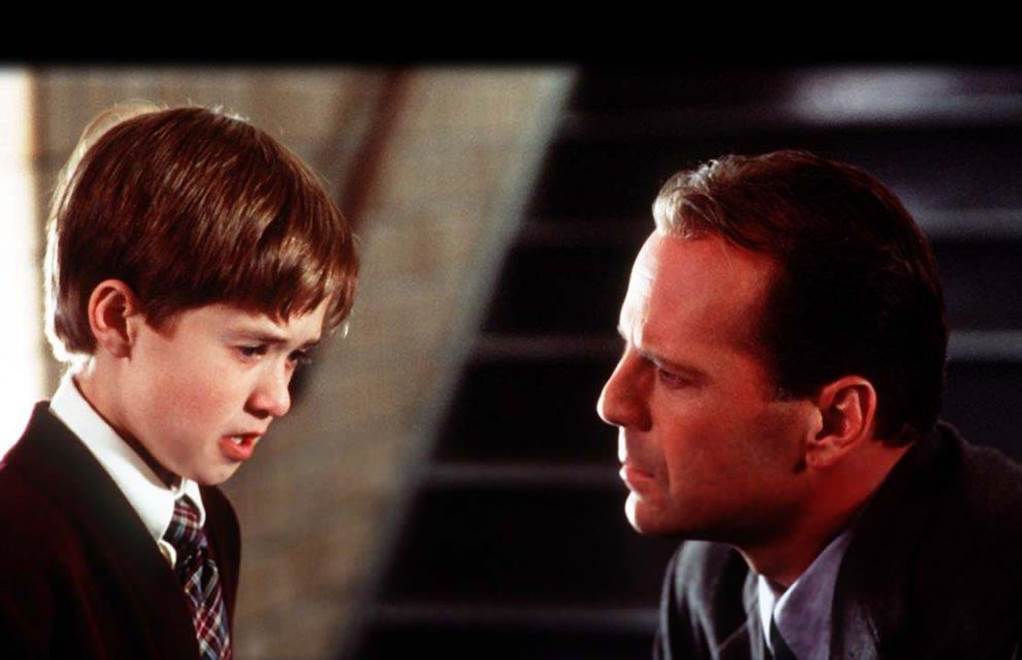
| from the film Sixth Sense |
Ghost stories
are usually not very philosophical. They are scary and reach down to touch our
primal fear of the undead, of spirits, of ghosts and wraiths. If you saw the
film Sixth Sense, you know that
ghosts want something. And, of course, this is more or less an assumption lying
behind all ghost stories. An spirit returns to earth not because they want to
but because something prevents them from achieving rest and peace after they
die—usually, some injustice done to them, something that must be corrected, set
right, understood, and let go of. In the story “Parody” a ghost appears who
cannot rest because something he has done in life is being coopted by what he
believes is an invalid form of art based on an invalid philosophy.
 |
| Postmodern architecture |
It begins when Andrew Halliway, a musician who is starting to make a name for himself in the world of guitar, sees someone standing on the sidewalk in front of his girlfriend Elizabeth’s apartment. He confronts the man, who disappears. Unsettled, he goes to her apartment. Elizabeth is an architect currently working on a project to expand the City Hall. The project has been bedeviled by delays, broken equipment, and other obstacles.
Elizabeth’s mode
of architectural design is postmodern. We hear that term today and usually
connect it with literary arts. The French
Lieutenant’s Woman is a postmodern novel, Shakespeare in Love is a postmodern film. But postmodernism began
as an architectural movement. In Italy, designers of buildings began to defy
categories (which is what postmodernism essentially is). They mixed up styles
that usually stood as monolithic, designing buildings that had gothic arches
and modern steel girders, Romanesque towers and glass and steel entry ways,
classic Greek pillars and baroque decoration.
And
postmodernism engages in parody. It will copy certain art forms, making light
of them in one sense but also calling attention to their brilliance. Writer
John Fowles once described a certain type of painting as “simultaneously a
tribute and a thumbed nose at a very old tradition.” This is often cited as a
definition of postmodernism. And, in my story, it is exactly what Elizabeth is
doing in her addition to the City Hall. She is copying the old design in a way
that calls attention to its eccentricities but at the same time recognizes its
genius and beauty.
 |
| Elizabeth |
They spend the night together. Andrew gets up before her, goes into the living room, and finds a book on architecture. Thumbing through it, he comes across a picture that looks like the man he saw staring up at Elizabeth’s lighted window. She appears at that moment and sits down beside him. He points to the photograph and asks who it is.
She tells him it is
Marvin Quinn, a local architect who died some
years ago and who designed the original City Hall. She smiles and adds, “He wouldn’t be happy if he knew I was doing a post-modern take on one of
his buildings.” When
Andrew asks her why she replies: “He
hated postmodern architecture—wrote some pretty nasty things about it. He’d
roll over in his grave if he knew what I doing with the City Hall project.” Though Andrew finds the idea impossible
he begins to see that Quinn has in fact rolled out of his grave.
Andrew sees more of Quinn. He is watching from a
distance when Elizabeth gives the city council a tour of the construction site.
He shows up at one of Andrew’s concerts she attends. He confronts the man, who
eventually admits he is Quinn returned to life and instructs Andrew to make
Elizabeth stop the building project. “Stop
her or I will,” he says. A few days later, Elizabeth has a seizure. The
doctors tell her it was from overwork. Andrew knows it was Quinn’s doing. Quinn
later appears to him and tells him he will not tolerate her postmodern parody
of his building and that he willing to “pay the price” to stop her. He doesn’t
say what the price is.
 |
| Dante's World |
Andrew wonders how one fights a ghost. But he also wonders what is preventing Quinn from further harming her; and why Quinn has appeared to him but not to her. The answer comes to him immediately. Elizabeth told him she had been reading Dante’s Divine Comedy in Italian, which she learned while studying architecture there. She mentions the line, The Love which moves the sun and the other stars. He realizes Quinn is hampered by the love he and Elizabeth share. It is hindering and preventing him from going after her. He summons Quinn and asks him to meet him at a local sculpture garden. He promises that if Quinn hears him out, he will try to persuade Elizabeth to abandon her project. Quinn agrees.
 |
| DaVinci's Horse, Grand Rapids, Michigan |
They meet by
the sculpture of Leonardo DaVinci’s horse—a project he designed but never
finished. As they stand there Andrew tells him that when a group of artists
decided to create the sculpture Leonardo never got to build, they ran into
trouble. “… when the artist began the project, she found
out the design was imperfect. Leonardo
was not good at drawing animals. The musculature was all wrong; the proportions
were off, the perspectives not realistic. Nina Akimo corrected all that. In
other words, she kept the general design of DaVinci’s project but improved on
it. You might even say Ms. Akimo’s work is a parody of DaVinci’s—one that
improved it. Elizabeth is doing the same thing. She isn’t mocking and
ridiculing your building, Mr. Quinn. She’s calling attention to its brilliant
features.”
Andrew persuades Quinn. He sees what Elizabeth is
doing. He only nods and vanishes, but knows the danger is at an end. He calls
Elizabeth and she says she slept well and feels fine. She invites him over. A
star falls as he leaves the sculpture park. He thinks of the love that moves
the sun and all the other stars.
“Parody” appeared in the Australian journal Roar
and Thunder, which has ceased publication but maintains an archive. Read it here.

For winter reading get a copy of The Sorceress of Time. Wuxia warrior Jing Lin travels time to understand how to win a battle and how to win the battles she faces in her own life. The key to the future lies in the past.
I would love to hear your comments.


