My last
two blogs talked about stories I have written that were odd, strange, weird, bizarre.
The one I will talk about today is a little more tame—well, sort of. It was a
fantasy story with a paranormal, supernatural element, but at least it followed
the usual format and satisfied the standard expectations such a story raises. “Straight
on Till Morning” is the story of a woman who is abducted by elves and about her
husband, who journeys to elven territory in order to find her and bring her
back.
In
Celtic lore, elves are not diminutive creatures with pointed ears who sit
around on toadstools and are cute and lovable. They are just the opposite. They
are rapacious, nasty, and dangerous—and, they possess magical powers to
facilitate their being rapacious, nasty and dangerous. The idea for this story
partially came from one of the best horror/supernatural stories I have read, Graham
Joyce’s Some Kind of Fairy Tale, a novel that presents elves as they are
traditionally understood by the ancient peoples of the British isles. They are
dangerous. They abduct and enslave humans. To free someone they have abducted you have to be as tricky and ruthless and they are.
 |
| Anisa |
Chauncy’s
girlfriend, Anisa, a rising star who performs Celtic music, disappears. Shortly
after that, he hears a musician he himself has done music with, Sossity Chandler,
state her belief in the supernatural. They talk and she suggests Anisa has been
abducted by the “fairy folk”—elves. They search the area where she disappeared
and find evidence for this. She suggests he sleep in the fairy ring they find
(a fairy ring is a ring of grass that can serve as a portal to the world
of elves). He does, bringing a guitar and supplies and, when he wakes up, finds
himself that world. He immediately sees Anisa.
She
has sensed him (living in eleven land she has already accrued small magical
powers) and chides him for coming and tells him the elf who abducted her and
now claims to own her and will also sense Chauncey is there. Sure enough, the elven man who abducted
he--Sutton--shows up. He and Chauncy argue. He says he will murder Chancey, who
calls him a coward to harm an unarmed man. The elf challenges him to a dual.
 |
| O'Carolan |
The other elves welcome Chauncey and arrange the duel. While he is there he learns more
about the elven culture and meets someone he venerates, Turlough O'Carolan. O’Carolan was an Irish harper from the late
fifteenth century whose music has survived and is widely performed today. (I am a musician
and have performed many of the tunes he wrote.) Chauncey hears him
play and learns he was abducted just before his death and brought to eleven land.
He tells O’Carolan about his upcoming duel with Sutton and his plan to win it.
The harper is amazed at his plan but tells him it just might succeed; and, he
says, when he plays for the Council tomorrow morning, he will put in a good word
for Chauncy.
The eleven Council meets to set up the terms of the dual. Chauncey is given choice of weapons.
The following exchange takes place. As Chauncey is the challenged party, choice of weapon is his.
“What weapon do you chose?”
“Guitar,” he said.
The Leader of the Council and
everyone else in the room, including Anisa, gaped. The Leader leaned forward.
“I’m not certain I understand
you, young man.”
“Guitar is a musical instrument.
I am challenging Sutton to a duel of music, not conventional weaponry.”
The Leader’s face showed a
mixture of caution, puzzlement, and censure. “This is most unusual,” she said.
“Music is the weapon I chose.”
“This has no precedent, but I am
intrigued,” a Council member who wore a funny-looked Renaissance hat said.
Chauncey remembered Carolan’s promise to speak to the Council. Perhaps this man
was one of Sutton’s enemies. “I can’t recall that such weaponry is forbidden.”
The Leader made to speak, but
another Council member—another woman—beat her to the punch.
“Our laws say the weapon be ‘a
thing in the use of which a noble is trained.’ All our nobility must learn
music of some sort.”
The Council withdraws, debates the lawfulness of music as
a weapon but decides Chauncey’s request is valid.
Chauncey is confident of victory, but Anisa tells him not
to be too self-assured. The elven nobles, she says, are trained in music from
childhood. And the people of the Council like the kind of music Sutton will most
likely do.
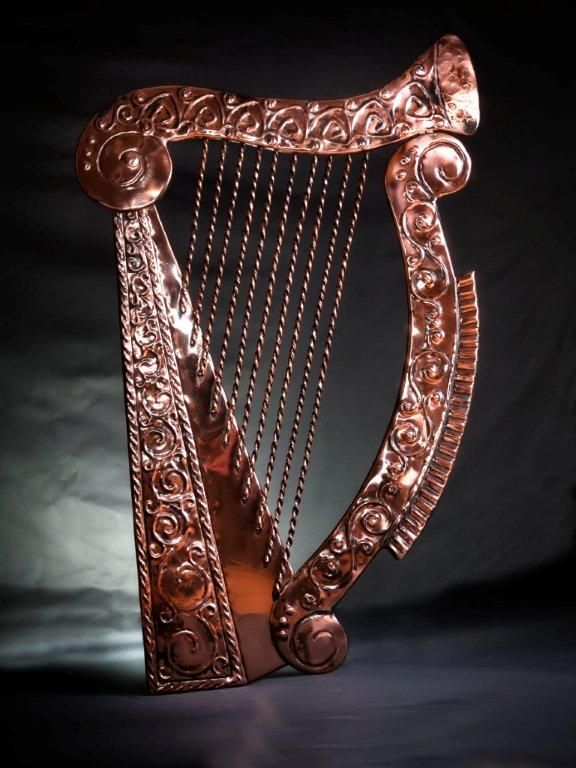
When the duel begins, Sutton sings and his performance is well-received. Chauncey plays guitar, performing songs by O’Carolan. The judges are stunned by the beauty of his music and declares him winner of the duel.
Sutton is now at his mercy. At the Council’s behest, the
demands all of his opponent’s land and money. He also calls upon an elven
woman he has come to know in his short stay there that she promised to grant
him a “boon.” She says she did and he can have anything he wants. He asks for
her slave girl Kelly, who had helped him on different occasions. The woman
willingly grants his request. He gives Kelly all of Sutton’s money and then
gives her as a bride to Raymond, a human who was kidnapped by the elves and has
decided to stay in their land. Sutton, he is told, will be punished for his illegal abduction of Anisa. They depart elven land and find themselves in a theater in
New York City where Sossity Chandler is performing. She greets them and
promises to arrange for their return to Ireland.
“Straight on Till Morning” appeared in Fiction on the
Web. Read it here.
For more good fantasy and paranormal, check out my novella, The Court of the Sovereign King.
Happy Reading.
For more good fantasy and paranormal, check out my novella, The Court of the Sovereign King.
Happy Reading.