 |
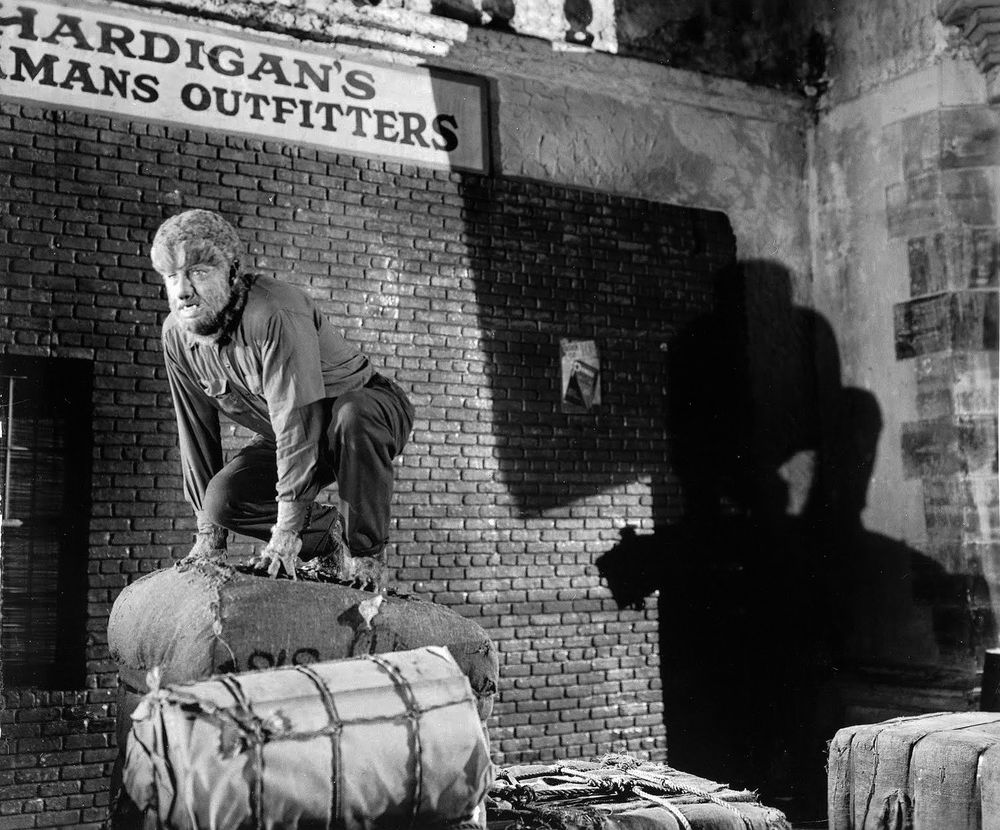
| Lon Chaney, Jr., as the Wolfman |
Writers
are like anyone else. They can get on a "kick" and they can get stuck
on a theme. I had written the story "Wolf Moon," a science fiction
story about werewolves marooned on a planet who manage to get free (see Dave's
Anatomy #32). And werewolves were on my mind. I would not say I got obsessed or
was on a kick. But the theme of werewolves is fascinating. Once, while watching
an old movie on TV where Lon Chaney, Jr., is undergoing the transformation to
his wolf-self, an aunt of mine, who, as far as I knew, was no great fan of
horror, and happened to walk in and see that little segment of the movie. She told
me, "I always feel sorry for the Wolfman. He doesn’t want it [the
transformation] to happen, but then it does and he can't stop it." Maybe
that's the essence of why we find werewolves fascinating (I would say this
applies to vampires too). Something happens you did not ask for and cannot
control. You fight against it, you take precautions against it, but eventually
it gets the better of you. Kind of like life, right? But werewolves bring in
the horror element.

In
the story, "The Girlfriend," boy meets girl. So far so good. Sabrina
plays violin for the city symphonic orchestra. She meets Wayne and likes him,
they begin to date and develop an intimate relationship. Everything about him
checks out—except for a few anomalous matters. Once a month, usually around the
time of the full moon, he is unavailable. Wayne works for a prosperous firm
that designs and builds various kinds of structures. Sabrina can see how he
might travel a lot, though sometimes his absences are disappointing.

Sabrina
is chosen to play the solo parts in Beethoven’s Violin Concerto in D, a
difficult piece that, if she executes it well, will advance her career. She
practices diligently but Wayne says he has to go to Europe when the concert is
scheduled. She asks if he can negotiate the trip because she wants him to be
there to see her perform. He insists he has to go and apologizes. Sabrina
performs a flawless and powerful concert. Her friends throw a party for her, but
her happiness is dampened by the fact that Wayne could not be there. She
reconciles her feelings. After all, he has a good job and it makes demands on
him. But when he meets one of Wayne's friends from work, she finds out he was
lying. The friend tells her he was at work all week long. He did not go to
Zurich.
Sabrina
is angry, to say the least. The following exchange takes place:
“Why did you lie to me,
goddamn it?” I hissed at him, my face red. “Tell me the truth.”
When he did not reply I
added, “Are you seeing someone else?”
“If
you’ll come over tonight I’ll try to explain.”
“Explain? Explain what?
Maybe you can call up your other girlfriend. Hell, we’ll have a ménage a trios.”
He
put up his hands, looked side to side, and spoke.
“There
was a reason I lied to you.”
“It
had better be a damned good one.”
“It
is. Come over tonight and you’ll find out all about it.”
“I
don’t know, Wayne. I’m not sure I want to hear your fucking explanation.”
“If
you don’t, don’t come. But I want to explain it to you, Sabrina.”
Sabrina
struggles with it and then decides to go. When she get to his house, his
sister, Constance, meets her. Wayne is nowhere to be seen. Constance takes Sabrina
downstairs. She suddenly finds herself enclosed in a small glass booth. A glass
wall separates it from an old basement that has been redone, the windows
sealed, all the furniture removed. Sabrina is suddenly seized with terror,
thinking the two of them are psychopaths who lure women into a soundproof area
and then . . . well, who knows what? Constance assures her this is not the
case.

Sabrina
sees Wayne. He stands on the other side of the glass, turns and opens the
window shade to the full moon, and begins the painful transformation to a
werewolf. She does not believe in werewolf legends and thinks they them "ignorant,
superstitious myth from barbaric eras in human history." Experience teaches
her how wrong she has been.
A technique
in writing effective horror is to make the supernatural real. In the old
movies, Lawrence Talbot (the old werewolf) and Tony Rivers (the teenage
werewolf) always manage to keep some clothes on for the sake of modesty. But
this is unrealistic, and the transformed Wayne rips his garments to shreds.
Sabrina is terrified but tells Constance she wants to watch. She does not want to
leave him. She manages to endure seeing him in his animal form.
Afterwards,
Constance tells how her brother became a werewolf. Constance falls asleep as
Sabrina contemplates where their relationship will go. Would she be willing to
help Wayne through a dysfunctionality she had not imagined really existed? She
thinks she will. The story ends with her contemplating the difficulties she
will face.
This story was published in Lightning Flash--now defunct, no archive.
For information on the books I've written, check out my Writer's Page.
For a great Christmas stocking stuffer (for adult stockings), get a copy of ShadowCity. In a dark world, the light within you is all you have.

I would love to see your comments.


