Wednesday, March 29, 2017

Dave's Anatomy: My History As a Writer, #98: Writing About Vampires: "Jancinda"

Bella Lagassi as Dracula

I started writing vampire stories about the time the Twilight series was winding down. I did not follow the series. I read one of the book and, for all the criticism of the writing I did not think it was all that bad for a Young Adult novel; I saw the last film and, once more, didn’t think it was stupid or kitschy. In fact, I thought that the twist at the end (that the battle between the two armies of vampires did not really happen but was only virtual reality) was clever. The main thing about Twilight, though, was that it gave vampires a bad name. I saw submission guidelines that said “No Vampire Stories”; some would allow the genre but said “no sparkly vampires.” I had some ideas so came up with my breed of vampire tales. The first one I wrote and published was called “Jancinda,” the name of the female protagonist in the tale. She would become an on-going character.


Vampire literature has changed and developed since it began in early 1800s. The vampires of the earliest stories, The Vampyre by John William Polidori (1819) and Carmilla by Sheridan Le Fanu (1872) were quite different from Bram Stoker’s Dracula (1897). Later on, Anne Rice’s novels, such as Interview With a Vampire, changed the vampire “world.” Other writers, like Stephenie Meyer with Twilight, continued to develop and alter the nature of vampire literature. I added my contribution, small though it may be, with the series of stories about the vampire Jancinda Lamott.

Carmilla and Laura

Vampires started out as creatures of complete evil. Dracula was bad and nothing else; no redeeming qualities in him. Carmilla, the lesbian vampire in that novel that bears her name, only wants to satisfy her thirst for blood and her passion for a young human girl, Laura. But by the time of Anne Rice, 1976 and onward, vampires become more complex, conflicted, and multilayered. By the time of Buffy, the Vampire Slayer and The Vampire Diaries they are complex characters.

Jancinda Lamott

My character Jancinda crosses over to the world of vampirism one winter night when she is bitten by one of the undead named Julian. Of those bitten, all but one in three thousand die. Some, though, become vampires through this contact, and Jancinda is one of the few that does. When a vampire bites a person who will transform, he or she has the duty to care for them and introduce them to the world of the undying. Julian, however, has no such scruples and leaves Jancinda lying in the snow to die when the sun comes up. A woman named Bonita Perez senses her and takes her into her apartment. The vampire Bonita begins to teach Jancinda how to live the new life she has entered.

Jancinda is able to adapt but struggles with what has happened to her. She has to kill (my vampires only need blood once a month). She sometimes anguishes over the ethics of this. Once she asks a friend, “How can God let something like this happen to us and then hold us responsible for it?” She sets up an online business that does resumes, grant writing, and editing, and does quite well. And she maintains a relationship with a human boyfriend named Wesley.

Bonita

The story “Jancinda” is about this. Wesley is suddenly dumped by Jancinda, wonders why, and persistently asks her why. She will not return his calls. She will not answer his letters. One night, drunk, he goes to her apartment and pounds on the door, demanding entry. To his surprise she lets him in. After some obfuscation, she tells him the truth:  that she has become a vampire.  He is afraid, thinking she is deluded and might kill him in her delusion that she is one of the undead. She proves it to him by showing how she has no reflection. Then he is afraid she will kill him because she is not deluded and wants to get his blood.

Jancinda promises Wesley she will not harm him. He sympathizes. He knows vampires drink blood, but he does not know that being a vampire enhances and sharpens your sexual desire. Jancinda’s vampire nature takes over, and they fall into their old lovemaking routine. He describes Jancinda as passion seizes her:  As I ran my hands over her breasts and stomach and down past the waistband of her shorts, I became aware of changes. Her skin pulsated with bursts of heat—so much heat I thought it might burn my fingers. Her skin paled. Her eyes filled with a fiery, hungry look. I felt her hands run over my back. Her nails had changed to sharp talons. Kissing her and putting my tongue in her mouth, I felt the smooth, sharp spears of fangs.


But their lovemaking does not change things a lot. Wesley sees her from time to time, though she still will not date him. When he runs into her and she is with her vampire friends, it makes him uneasy. They eye him like he’s a very attractive piece of meat they would love to wrap up, carry home, and dine upon.

Later, though, he gets a desperate phone call from Jancinda. She has been in an automobile accident that jammed the doors of her car shut. The police and a crowd of people are there, so can’t use her vampire super-strength to break the doors or transform to a bat and fly away. She asks him to come. He arrives just before dawn. The police say she can go. Hardly able to breathe because the sunrise is upon them, she wraps up in a sun-proof blanket, Wesley secures her in the trunk of his car and delivers her to a “safe house” where she will be shielded from light.

His act of valor makes Jancinda see why she loved him when she was mortal. They begin their relationship once more. Jancinda says she will accommodate him and tell the other vampires to leave him alone. Neither of them know where the relationship will go, but they intend to maintain it. More stories about the vampire Jancinda Lamott would follow.

“Jancinda" appeared in the anthology Bite from the Heart, available on Amazon. Get a copy here. 

If vampire stories are your thing, check out my novella, Sinfonia:  The First Notes on the Lute, A Vampire Chronicle, Part I, available here.

I would love to hear your comments.

Happy reading.

Friday, March 17, 2017

Dave’s Anatomy: My History As a Writer, #96. Writing from Long-Held Questions: “The Slave Girl and the Angel Israfel.”


I had always been intrigued by the quotation Edgar Alan Poe uses as an epigraph for his poem, “Israfel.”  It is this:  And the angel Israfel, whose heart-strings are a lute, and who has the sweetest voice of all God’s creatures. —KORAN.” I got a copy of Poe’s works for Christmas when I was age thirteen, but I didn’t examine the quotation until many years later. I looked for it in the Qur’an, but could not find it. I did some searches and couldn’t find it on any of the popular search engines. I did, however, run across someone who had a much better knowledge of the Qur’an (I knew this because he used technical terms I did not know). It seems that Poe either just made the quotation up or got it from a source that misquoted it. I liked the poem, the opening stanza of which reads

In Heaven a spirit doth dwell 
   “Whose heart-strings are a lute”;   
None sing so wildly well 
As the angel Israfel, 
And the giddy stars (so legends tell),   
Ceasing their hymns, attend the spell   
   Of his voice, all mute. 

Even misquotes, however, can begin the imagination working and I came up with an erotic story, “The Slave Girl and the Angel Israfel.”

Hala

It centers on a young woman named Hala. She is sold as a slave to pay a debt and lives in a coastal city. She is a Christian, her owners are benevolent, though when she comes of age, her duties include servicing their son, a thing Hala comes to accept and eventually enjoy. She wonders if he will marry her but her world is jarred when he gets in trouble with the authorities. To pay his fine, or to perhaps pay a bribe, the family sells her. She ends up in the slave market in Baghdad. She is sold to an older man and takes up his place in his home.

As his mistress, she has privileged status in the house. Very quickly, however, she encounters a woman named Fatima, who bullies her. After her first experience in bed with her master, she is lying down, contemplating, when Fatima bustles into the room:


Get up, you lazy whore,” she said.
Hala glared at her.
“Up, unbeliever—and don’t look at me like that or I’ll make you pay for your insolence.”
Hala got up. The woman led her to a bath chamber. Again, she pushed her along, cursing her all the way. Hala’s anger flared. She turned and again glared at the woman. She swung her hand to slap Hala, who seized her fingers and sunk her teeth in them.
She bit down as hard as she could. The woman began to scream.
“Murder!” she cried at the top of her voice. “Murder! This kaffir is trying to kill me!” She bellowed and roared as Hala clamped her teeth with all the force she could call up.
She heard scrambling and clattering. The young man she had admired earlier in the day came bursting into the room, scimitar drawn.

The young man who comes to the scene, named Suleiman, creates order. After he leaves, taking Fatima, Hala realizes she has been standing there, naked as the day she was born, all the time he was in the room. She thinks him extremely attractive.

Fatima is disciplined and reduced in rank as a servant for her behavior. Hala is assigned a servant girl who tells her Suleiman is their master Daroysh’s bodyguard. Like them, he is a Christian but is not permitted to serve in the army or the police because of his religion. Hala begins to dream of him and the two of them get to know each other. Suleiman is attracted to Hala, but does not think they should risk being found out and so will not become her lover.


Time passes. One night she dreams of the Angel Israfel, whose heartstrings are a lute. She awakes from the dream to find Suleiman in her room. He has not been able to resist the love he feel for her and she joyfully yields to his embrace. They become lovers.

During her time in the seaside town where she lived her many years, Hala had learned to play the lute from the daughter of English merchants residing there. She has asked Daroysh to purchase one for her and he does. She tells Suleiman she will be playing at a dinner tonight for Daroysh’s friend Kharki, who is highly critical of him for hiring unbelievers, Christians, Jews, and Zoroastrians.  Kharki will not sit with unbelievers, so Suleiman says he will listen from within the next room.

That night, Kharki makes an attempt on Daroysh’s life, hoping to take his position working for the government. Aided by Fatima, he announces he will kill Hala first. Just then Suleiman and some guards come into the banquet hall, kill Kharki, and capture his henchmen. He later tells Daroysh that he knew to come to his aid when he heard discordances from Hala’s lute. She never played discordant music. Daroysh is grateful, gives Hala her freedom and permission to marry Suleiman. They live long and happy years together. She never forgets her dream of the Angel Israfel.


The story appeared in an erotica journal called Oysters and Chocolate, which is no longer published. You can read it, however, in a special issue of Erotique that consists entirely of my erotica—“The Slave Girl and the Angel Israfel,” and a number of other stories about relations and the joy of love. Take a look at their website here.

For additional titles see my Writer's Page.

If vampire stories are your thing, a unique and unusual tale is Sinfonia: The First Notes on the Lute: A Vampire Chronicle, Part I.


For another multicultural story, I recommend The Sorceress of Time.

Happy reading.

Monday, March 6, 2017

Dave's Anatomy: My History As a Writer, #95, ShadowCity


World-building is the prime attraction of fantasy and fabulism. Skillful writers create worlds that are places of danger and adventure—places we want to live despite their threats—magical worlds full of adventure and possibility. Narnia, Middle Earth, Earthsea, Darkover, Avalon—the list is long. When a writer creates a world, he or she can also create the rules. Different races of beings, the existence of magic, religion, topography—everything is at the writer’s power. It is intoxicating. It was the lure that led me to create the world of ShadowCity.

ShadowCity was the third book I published—a novella, a fantasy story about a parallel world that exists in tandem with earth as a dark copy. The world, you come to understand, is a developing word—a site that is embryonic and waiting to take its place in the universe. It has a guardian, a young woman from earth named Jimena Chagall. The main character in the book, Scott Evard, was in love with her but her erratic lifestyle, drug use, and enigmatic disposition has split them up. He meets her by a river walking path near a bridge, a place where panhandlers hang out, begging money. She is thin and smells as if she has not bathed in several days. He gives her money and offers to take her to his apartment where she can rest and bathe. “You just want to see me naked,” she quips. “Like I haven’t seen you that way before,” he mutters. As he walks away, someone tries to murder her. Scott, a boxer in college, manages to save her and beat her assailant insensible. They call the police, who take her for questioning. Mark has a business meeting he has to attend and promises he will come to get her at the police station.

Jimena

When he does, she kills her assailant by removing the shadows from his room. The police think he has had a heart attack. Jimena fills him in on the aspect of her life he has never known about. She the guardian of a world but has neglected her duty. As a result of this, darkness has almost completely taken the forming world over. The evil has become so strong, the evil rulers of the world have sent a killer to Earth to murder Jimena. She realizes she has to go and try to correct things, though at this point it seems like a hopeless endeavor. She and Scott sleep together that night. She dresses and slips off, but Scott wakes up and follows her into a large shadow. He ends up in the parallel world.

The plot is intricate, but the world-building merits mention. The world, Jimena tells Scott, is a copy of Earth “all based on string theory” but too complicated to explain. It is a refuge for people who know darkness and loss:  those who have been harmed by the dark forces on Earth, and those who are themselves dominated by darkness. The latter have gotten the upper hand, and Jimena must right the situation.

But from the beginning, Scott notices her methods smack of darkness and cruelty. She buys a slave (Drya, a Maenad), tortures a woman, bullies and intimidates both enemies and friends. She captures a young woman warrior and promises Scott he will not let her people harm her for treason but ends up doing nothing to stop the girl from being hanged. When Scott chides her, she says he will not like everything she does but she must resort to such methods in order to set the situation right.

Drya

What Jimena does not understand is that in behaving as she does she is letting the darkness that threatens to engulf the world seep into her soul, weakening her. She is in danger of being overwhelmed by the very thing she is fighting.


What happens? You’ll have to get a copy and read it to find out. It is a fast-moving story of love, struggle, adventure, and magic. It explores, like Lord of the Rings and The Earthsea Trilogy, the nature of good and evil. You can order a copy here. It's a great read and an exploration of a fascinating world that exists as a shadow of our own world.

For other great titles, check out my Writer's Page.

Are vampire novels your thing? Read Sinfonia:  The First Notes on the Lute. A young woman's love of music is only matched by her love of human blood. See the video.

I would love to hear your comments.

Friday, February 17, 2017

Dave’s Anatomy: My History As a Writer #94: The Past As a Good-Bye: “Gimme Shelter”


As a guitarist and a Rolling Stones fan, it’s natural that some of my stories come from those things. I write a lot about musicians:  realistic stories about the trials of being in the music industry, stories where musicians encounter the supernatural, tales of musicians and their relationships. I can draw on my own experience, my knowledge of music, and elements in popular culture for plot ideas. And I created an ongoing character, Sossity Chandler, who toils and plays in bars and small venues until she makes it big and becomes a pop music superstar. The story for today, “Gimme Shelter,” uses that particular song as a jumping off point for a story about a guitarist who has found his niche in the world of music writing and his on/off girlfriend, Orion (Orion is pronounced like the Lake in Michigan, not like the constellation). He learns a lesson about himself from the song.

Orion

In the story, Eliot is with Orion. In their early days they both have aspirations to make it as musicians, and they both faith, though in different ways. Eliot ends up going into the academic world, earns an advance degree, finds a job, and is able to make it the world of scholarship. Orion tries to establish a career as a singer but has little success. She lives a hard-scrabble life, working from gig to gig, hardly making enough money to get by. Eliot’s career takes a turn when he grows weary of purely academic writing and pens a book on British acoustic guitar players. It is an unexpected best-seller and catapults him into the world of music writing.

He maintains a relationship with Orion. They continue as occasional lovers. He gives her money when he senses she is barely getting by. When he does research on themes related to music and popular artists, she often accompanies him. Just off a breakup with a woman he had hoped to marry, he goes with her from their home in Grand Rapids to Lansing, where she is playing a gig in a bar. On the way up they listen on old Rolling Stones records and comment on the music. Despite the fact that he talked about her in an article on upcoming blues artists that was published in Billboard, her career is not going well. She is out of money. He does the usual thing of giving her a large amount of cash to buy them drinks. She will keep the substantial cash that is left over.


As he is watching Orion play, a woman sits down with him. She is also a college instructor and likes his writing. They talk literature. She mentions an article he has written about Michigan author Bonnie Jo Campbell. She says she likes his analysis of the story:The main character’s interpretation of his relationship to Belle when they were teenagers is the opposite of her interpretation. He saw himself as her savior and champion in those early days; she saw him as someone who sexually exploited and took advantage of her.” He mentions a similar theme in Julian Barnes’ novel The Sense of an Ending. It is obvious the woman is coming on to him, but in the middle of the conversation he has an epiphany—a moment of realization. He says he needs to go, she leaves her phone number. He thinks about Orion and how he has treated her:


As he picked up his guitar case, he realized how he had exploited her—yes, he told himself, exploited described it perfectly. In graduate school he had depended on her for emotional support when he was fatigued, discouraged, or overwhelmed—frequent occurrences for graduate students. More than once she had typed papers for him. She had always been willing to sleep with him when she sensed he needed it. She stuck with him when he was down and as a “friend” when Janelle was cutting him to pieces. She had always been there. Through the years she had borne his whining and condescension like a patient mule. She had supported him emotionally. And how had he responded? He had screwed her, given her money when she was broke, attended her concerts—and when he attended her concerts, they usually ended up in bed together. Exploitation—flat out, no way to sweeten what he had done with a euphemism and no excuse for it.

Eventually, as he and Orion have agreed, they do a couple of songs together. Afterwards, he says he wants to talk to her. She senses his agitation and wonders what is going on. He asks if she knows a place where they can go to talk. Still puzzled at his behavior, she suggests a coffee bar she knows that is open 24/7.

I let the reader imagine what will result from his epiphany, his moment of realization (a technique made popular by Irish writer James Joyce in his short story collection Dubliners). The fact that he has seen his behavior in this new light is at least hopeful.


The story appeared in the online journal Intellectual Refuge. Read it here.

For additional titles, check out my Writer's Page.

A great read is my vampire novel, Sinfonia:  The First Notes on the Lute, A Vampire Chronicle, Part I.  Get a copy here.


I would to hear your comments. Happy reading.  

Friday, February 10, 2017

Dave's Anatomy: My History as a Writer, #93: Ghosts and Justice: "Plantation Ghost."


Ghost of Hamlet's Father

Ghosts are not just ghosts. They appear in stories not just to scare us but to teach moral or sociological lessons. The four ghosts that appear in A Christmas Carol—ghost of Marley, of Christmas Present, Christmas Past, and Christmas future—are part of a novella about social justice and fairness for the poor. The ghost of Hamlet’s father asks for revenge after he is murdered so his brother can make himself king. The ghost in Toni Morrison’s Beloved, described as “spiteful. Full of a baby’s venom,” is an icon calling attention to racial injustice and the suffering of African-Americans during the years of slavery in the United States. In my story, “Plantation Ghost,” I try to illustrate some aspects of racial conflict in America through the presence of a ghost. The story calls focuses on this, but also illustrates the complications of being black and white in our society.

Rebecca Hayes, the bass player in Sossity Chandler’s band, is black. She has been dating the band’s drummer recently, who is white, but they have split up—sort of. Rebecca has caved in to pressure from her family to break the relationship off. But that has not been as easy as she has imagined it would be. For one, she loves Todd and he loves her. During the story she goes in to confront him and ends up making love to him. She is frustrated, as he is, knowing she has to take decisive action to end the relationship but not really wanting to.

When the band is doing a series of concerts in Alabama and Georgia, Rebecca and Sossity share a room at a plantation that has been turned into a B&B. Rebecca wakes up in the middle of the night to see a tall, slender black woman dressed in garments that suggest the 1800s standing at the foot of her bed. The figure vanishes and Rebecca writes it off as a dream. At the breakfast table that morning one of the guests asks if anyone there saw the ghost. Rebecca asks about it and finds out more:

“She is one of the most well-known ghosts in the area,” the white businessman, who had a heavy Southern accent, was saying. “This place was deserted for years because of her. More than one family moved in and the ghost supposedly drove them off.”
“Did the ghost go away?”
“A few people say they’ve seen her, but I guess she’s a little calmer—so calm she hasn’t rattled chains or terrified anyone lately.” Everyone around the table chucked at this. “People who have seen her identify her as a woman who worked her as a servant in the Reconstruction era, though, sadly, we don’t even know her name. She died a victim of racial violence, I think.”
Since racial violence was a delicate subject, the guests quickly moved the conversation elsewhere.

Later, the ghost appears to Rebecca and speaks to her. She tells the story of having been chased by ex-Confederate soldiers after the civil war and being shot. She staggers into a swamp for safety, finally collapses and his found by a white man who nurses her back to health. He lives alone, has lost his wife, and eventually Shoshanna and he fall in love. He is able to pass her off as a farm and worker and mistress, which the other men in the area can tolerate. They live together ten years and have two children. Charlie, the husband, eventually dies during a typhus epidemic. Shoshanna gives the children to relatives to raise and goes off to seek employment. She finds work at a plantation with white people who are fair and kind to her.


But by that time the Ku Klux Klan has become active. They don’t like the family that has hired Shoshanna and begin to harass them and her. One night they come to lynch her. In the struggle, one of their number drops a pistol on the ground. It goes off and kills her. The family buries her and leaves the plantation. Shoshanna becomes a ghost. She haunts anyone who has any connection with the mob of men who killed her—which is most everyone in the town and surrounding area. The plantation sits empty for years until someone from the north buys it and opens it as a bed and breakfast. Rebecca suggests that since Shoshanna has told her story and the direct relatives of men who murdered her are all dead, she can go to her rest. Shoshanna does not reply. She vanishes.

As Rebecca and Sossity are getting ready to leave, the woman who runs the place gives them a tour of the servants’ quarters. A box of old books she is giving away sits on a table there. Rebecca come across Shoshanna’s diary. She tells the woman it might be valuable, but the woman insists Rebecca take it. On the way home, Sossity asks her about Todd. Rebecca says it is over with them. Sossity argues she needs to defy her family and convention and pursue the relationship, since she really does love. Sossity tells Rebecca that she needs to do what is right. Her reply is, I think, some of the best lines I’ve ever written:  “I love him. No doubt about that. You told me I needed to do what was right. But sometimes you can’t do what is right in life. Sometimes you have to do what is wrong.” The story end on an unhappy but perhaps sadly realistic note.


“Plantation Ghost” appeared in The WiFiles. Read it here. The journal, no longer published but maintaining an archive, has a straight-line format, so you'll have to scroll down to get to my story. It's number four in the line-up.

Here's a video for my novel, Sinfonia: The First Notes on the Lute. Vampires, love, music, passion, and intrigue. Also, Shakespeare, and Queen Elizabeth.

For more titles, visit my Writer's Page.

I would love to hear your comments.

Sunday, January 29, 2017

Dave’s Anatomy: My History As a Writer, #92: Postmodernism/Love: “Parody.”

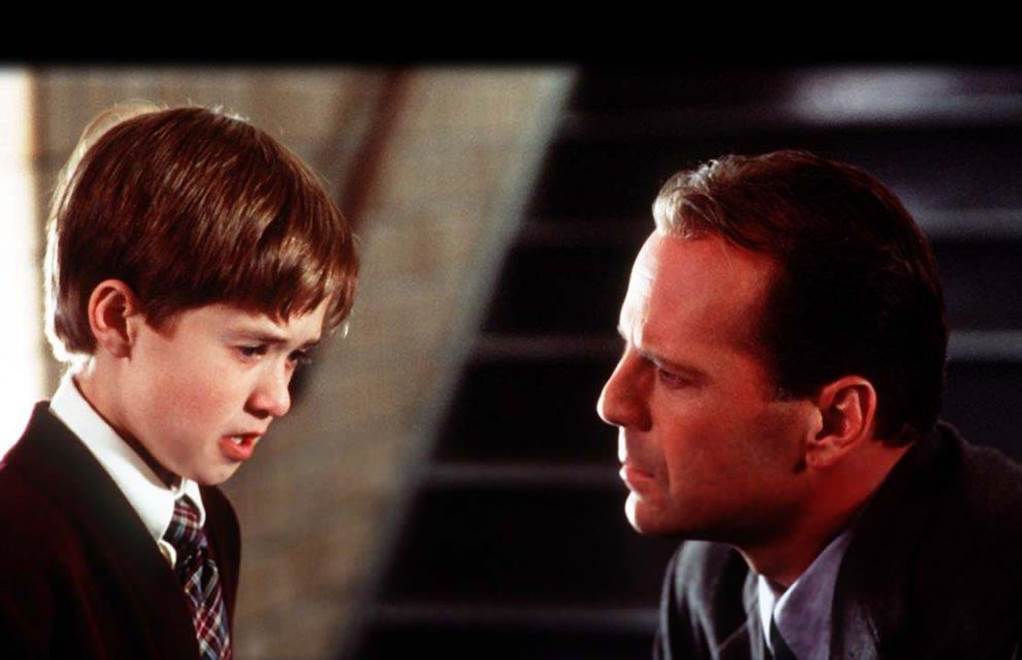
from the film Sixth Sense

Ghost stories are usually not very philosophical. They are scary and reach down to touch our primal fear of the undead, of spirits, of ghosts and wraiths. If you saw the film Sixth Sense, you know that ghosts want something. And, of course, this is more or less an assumption lying behind all ghost stories. An spirit returns to earth not because they want to but because something prevents them from achieving rest and peace after they die—usually, some injustice done to them, something that must be corrected, set right, understood, and let go of. In the story “Parody” a ghost appears who cannot rest because something he has done in life is being coopted by what he believes is an invalid form of art based on an invalid philosophy.

Postmodern architecture

It begins when Andrew Halliway, a musician who is starting to make a name for himself in the world of guitar, sees someone standing on the sidewalk in front of his girlfriend Elizabeth’s apartment. He confronts the man, who disappears. Unsettled, he goes to her apartment. Elizabeth is an architect currently working on a project to expand the City Hall. The project has been bedeviled by delays, broken equipment, and other obstacles.

Elizabeth’s mode of architectural design is postmodern. We hear that term today and usually connect it with literary arts. The French Lieutenant’s Woman is a postmodern novel, Shakespeare in Love is a postmodern film. But postmodernism began as an architectural movement. In Italy, designers of buildings began to defy categories (which is what postmodernism essentially is). They mixed up styles that usually stood as monolithic, designing buildings that had gothic arches and modern steel girders, Romanesque towers and glass and steel entry ways, classic Greek pillars and baroque decoration.

And postmodernism engages in parody. It will copy certain art forms, making light of them in one sense but also calling attention to their brilliance. Writer John Fowles once described a certain type of painting as “simultaneously a tribute and a thumbed nose at a very old tradition.” This is often cited as a definition of postmodernism. And, in my story, it is exactly what Elizabeth is doing in her addition to the City Hall. She is copying the old design in a way that calls attention to its eccentricities but at the same time recognizes its genius and beauty.

Elizabeth

They spend the night together. Andrew gets up before her, goes into the living room, and finds a book on architecture. Thumbing through it, he comes across a picture that looks like the man he saw staring up at Elizabeth’s lighted window. She appears at that moment and sits down beside him. He points to the photograph and asks who it is.

She tells him it is Marvin Quinn, a local architect who died some years ago and who designed the original City Hall. She smiles and adds, “He wouldn’t be happy if he knew I was doing a post-modern take on one of his buildings.” When Andrew asks her why she replies: “He hated postmodern architecture—wrote some pretty nasty things about it. He’d roll over in his grave if he knew what I doing with the City Hall project.”  Though Andrew finds the idea impossible he begins to see that Quinn has in fact rolled out of his grave.

Andrew sees more of Quinn. He is watching from a distance when Elizabeth gives the city council a tour of the construction site. He shows up at one of Andrew’s concerts she attends. He confronts the man, who eventually admits he is Quinn returned to life and instructs Andrew to make Elizabeth stop the building project. “Stop her or I will,” he says. A few days later, Elizabeth has a seizure. The doctors tell her it was from overwork. Andrew knows it was Quinn’s doing. Quinn later appears to him and tells him he will not tolerate her postmodern parody of his building and that he willing to “pay the price” to stop her. He doesn’t say what the price is.

Dante's World

Andrew wonders how one fights a ghost. But he also wonders what is preventing Quinn from further harming her; and why Quinn has appeared to him but not to her. The answer comes to him immediately. Elizabeth told him she had been reading Dante’s Divine Comedy in Italian, which she learned while studying architecture there. She mentions the line, The Love which moves the sun and the other stars. He realizes Quinn is hampered by the love he and Elizabeth share. It is hindering and preventing him from going after her. He summons Quinn and asks him to meet him at a local sculpture garden. He promises that if Quinn hears him out, he will try to persuade Elizabeth to abandon her project. Quinn agrees.

DaVinci's Horse, Grand Rapids, Michigan

They meet by the sculpture of Leonardo DaVinci’s horse—a project he designed but never finished. As they stand there Andrew tells him that when a group of artists decided to create the sculpture Leonardo never got to build, they ran into trouble. “… when the artist began the project, she found out the design was imperfect.  Leonardo was not good at drawing animals. The musculature was all wrong; the proportions were off, the perspectives not realistic. Nina Akimo corrected all that. In other words, she kept the general design of DaVinci’s project but improved on it. You might even say Ms. Akimo’s work is a parody of DaVinci’s—one that improved it. Elizabeth is doing the same thing. She isn’t mocking and ridiculing your building, Mr. Quinn. She’s calling attention to its brilliant features.”

Andrew persuades Quinn. He sees what Elizabeth is doing. He only nods and vanishes, but knows the danger is at an end. He calls Elizabeth and she says she slept well and feels fine. She invites him over. A star falls as he leaves the sculpture park. He thinks of the love that moves the sun and all the other stars.

“Parody” appeared in the Australian journal Roar and Thunder, which has ceased publication but maintains an archive. Read it here.


For winter reading get a copy of The Sorceress of Time. Wuxia warrior Jing Lin travels time to understand how to win a battle and how to win the battles she faces in her own life. The key to the future lies in the past.

I would love to hear your comments.


Wednesday, January 18, 2017

Dave's Anatomy: My History As a Writer, #91: Creativity in Art and Life: "Zen and the Art of Marriage"


There really are times when I get away from the werewolves, vampires, ghosts, and demons of paranormal and write about the more quotidian matters of life. "Zen and the Art of Marriage" explored several notions that float around in my thinking. One is the nature of creativity—both the good and the bad side of it. The other is marriage. What is the essence of marriage and the nature of it? Why do some marriages succeed and many others fail? Is an artist’s creativity inimical to marriage? What makes for a proper balance in an artist’s life between the creative and the quotidian?

These considerations came from a couple of things I noted on the matter. Artists seem hard to get along with. Milton was divorced—a rare thing in his day. Solzhenitsyn—even though, like Milton, he was a very devout Christian—could not get along with his wife very well. And we hear of artists who can’t seem to get along with anyone, let alone a spouse. I had also read an article in a magazine by a woman who was an artist and finally ended up divorcing her husband because she felt she did not feel “free to be creative” because she was married (even though her husband was, by her confession, loving and considerate and they had a good relationship).

Is there something about being creatively gifted that alienates? Is the artist the brooding Byronic hero, too restless and moody to love anyone? These were some of the questions that went into “Zen and the Art of Marriage.”

Desmond is a painter. He is successful, always finding enough work and does well for himself. He has recently split with his wife, Joanna. They have children. What has split them up is Desmond’s behavior when he is working on a project. He becomes angry, touchy, and intense. His wife and kids know not to talk him. He stalks the house, brooding, ultra-focused, unable to be civil to anyone. Finally, they split. Desmond is shocked, but Joanna has put up with him for too long to want to be reconciled. She takes the children and moves out. Alone, Desmond despairs. And to fill up the empty hours he begins to study Zen. The study helps him to understand himself. He invites Joanna to stay with him at a remote cabin in Canada his family owns—so remote you have to fly in to get there. To his surprise, she agrees.

They fly up together. She is cordial but distant. They are civil until he brings up Zen and tells her it has changed him. He asks if she has read a book on Zen he sent her. She unloads on him:

I read a little of it. I don’t want to read books. You should have been reading books like that before all this happened.”
He had not expected such a level of hostility as he caught in her tone.
“It’s a good book and it really helped me, Joanna.”
“About five years too late. You think you can treat me like you did the last years we were together then undergo some kind of”—she searched for a word—“conversion and that will make everything all right? It’s still just about you, isn’t it? You read a book and that should cure the whole problem. The problem, Desmond, isn’t me! It’s you. If you could get that through your head you might understand why I left you.”
Her attack cut through him so much he did not know what to say. The scenario he had built up in his mind of an even, civil, heartfelt conversation that would end in reconciliation dissolved like sugar in hot tea. She was angry. He had hurt her and words were not going to repair the damage he had done to her soul.
When he did not answer, she drummed her fingers on the tabletop.
“That’s how I feel,” she said, her voice softer and more conciliatory. “I can’t pretend I feel any differently. I pretended I felt fine for years when we were married and I can’t do it anymore.”

He realizes his plan has failed. They do some things together. He paints a watercolor of her and, as he works, tries to modify how he behaves when painting. They boat, see bear and moose, and get caught in a torrential rainstorm. She seems to have fun. Seeing her naked when they come back, soaked, to the cabin rekindles his passion for her. Desmond desires reconciliation, but after their spat he cannot find words and they spend most of their time together in silence. At one point she weeps over how terribly the divorce has hurt their kids. He comforts her silently. Despite this, Desmond decides he has lost the bid. They will not reconcile. This deepens the silence between them, though the silence is not hostile. Before he goes to bed that night, he reads from the Tao Ti Ching

Those who know do not talk.
                        Those who talk do not know.

                        Keep your mouth closed.
                        Guard your senses.
                        Temper your sharpness.
                        Simplify your problems.
                        Mask your brightness.
                        Be at one with the dust of the earth.
                        This is primal union.

                        He who has achieved this state
                        Is unconcerned with friends and enemies,
                        With good and harm, with honor and disgrace.
                        This therefore is the highest state of man.

Lao Tzu
In the morning, he finds a note from her. It reads, I am at the lakeshore, bathing.  Please come to me. He finds her there naked. They make love. Through silence, he has opened the door to reconciliation. Desmond knows it will not be easy but also knows—through the silences that have brought him the truth about himself and her—that there is hope and their relationship can be mended. When the pilot returns for them, he and Joanna are ready for the endeavor. They sit together in silence on the flight, knowing there will be plenty of time to talk when they get home.

The story appeared in a zine called Dirty, Filthy Secrets. As I recall, the journal did not last long. I can’t find a reference to it on the internet, let alone an archive. So many journals only have a short run and so many good stories get lost in cyberspace. This may be another I need to resubmit. Of course, it seems I'm saying that way too much lately.


For additional titles, see my Writer's Page.

For another love story, one that is indeed about vampires and the paranormal, get a copy, print or electronic, of Sinfonia: The First Notes on the Lute. Nelleke is world-renown lutenist and guitarist. She also has an appetite for human blood. 


 I would love to hear your comments.